Research

Cell-state control of developmental transitions

My research examines how the physiological and organisational state of a cell determines its capacity to interpret endocrine signals, withstand stress and persist through organism-wide tissue remodelling.

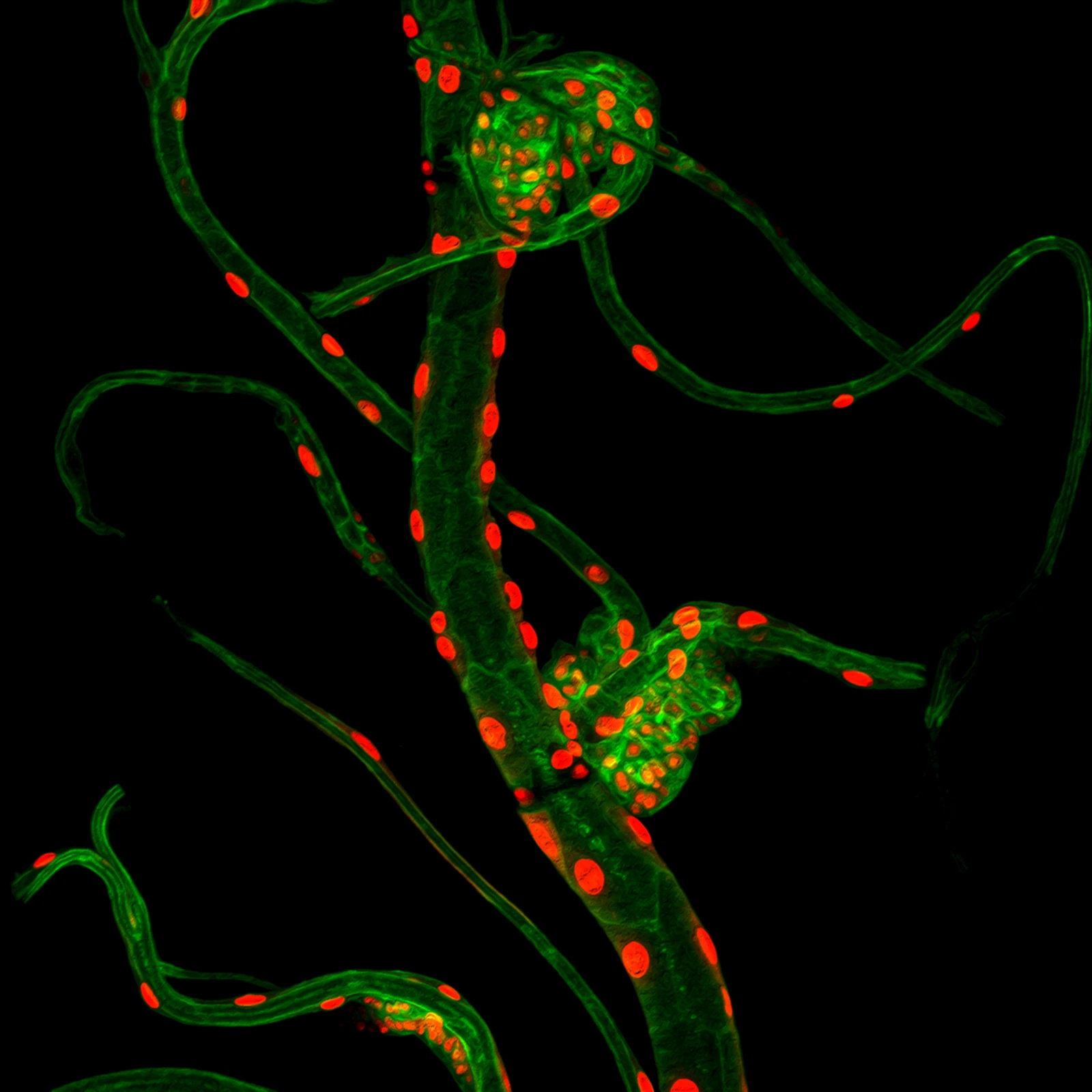
Confocal microscopy image from developmental biology research
Confocal microscopy. Image: Panagiotis Giannios.
01

The biological problem

Why do cells exposed to the same developmental environment follow different fates?

Developmental transitions require different tissues to follow different trajectories. Some cell populations persist, some change their function, and others are eliminated. Because these tissues are exposed to the same systemic developmental environment, signal exposure alone cannot explain their different outcomes.

My research focuses on cellular competence: the structural, physiological and regulatory properties that determine how a cell responds to a common signal.

I use the larval-to-adult transition as an experimentally tractable model to investigate how ploidy, differentiation state, stress physiology and biomolecular organisation shape this competence.

Central questionHow does cell state determine whether a common developmental signal produces adaptation, persistence, remodelling or elimination?

02

Connected research questions

Genome amplification and cellular capacity

Polyploidy is a widespread feature of differentiated tissues. Genome amplification can support specialised cellular functions, but it also changes cell size, biosynthetic demand and intracellular organisation. I investigate how the degree of polyploidy influences the capacity of differentiated cells to persist through major developmental transitions, and whether increasing genome content creates quantitative changes in cellular competence or vulnerability.

Endocrine signals and selective tissue responses

Hormonal signals coordinate developmental timing across the organism, yet their effects differ substantially between tissues. My work examines how pre-existing cellular state modifies the interpretation of endocrine signals and helps determine whether their outcome is adaptive, remodelling or destructive.

Stress adaptation and biomolecular organisation

Developmental transitions impose substantial biosynthetic, metabolic and organisational demands. Cells must maintain gene expression, protein homeostasis and intracellular transport while responding to rapidly changing signals. I study how ribonucleoprotein granules and associated proteins, including Headcase, contribute to this adaptive capacity, and how the organisation of RNA and proteins influences stress tolerance and developmental responses.

Autophagy and tissue elimination

Once a tissue becomes competent for elimination, degradative processes contribute to its dismantling. My research has examined how autophagic programmes participate in developmental histolysis and how their activity relates to the polyploid state of differentiated tissues. In this framework, autophagy is part of the machinery through which a prior cell-state-dependent decision is executed.

03

Interdisciplinary biological physics

Biomedical optics and tissue state

My research also extends to the interface of biology, physics, engineering and clinical medicine.

Within biomedical optics, I have investigated the optical properties of fresh human tissues and developed approaches for characterising light–tissue interactions. This work asks how physical measurements reflect biological organisation and whether optical properties can support clinically relevant distinctions between tissue states.

It has included studies of refractive behaviour in normal and pathological tissues, methodological development for measuring attenuating biological media, and collaboration across experimental, physical and clinical disciplines.

See biomedical optics publications
04

Direction and selected contributions

From developmental competence to general principles of tissue persistence

The long-term aim of this research is to identify general principles through which cell state creates developmental competence or vulnerability.

Understanding these principles may help explain how ploidy, differentiation, stress adaptation and intracellular organisation influence tissue persistence not only during development, but also in regeneration, ageing and disease.

View the full publication record